

There are many different charity CRM options available these days. But which of them understand your special needs as a Nonprofit?
What can replace your cumbersome excel spreadsheets?
Which can answer questions like ‘How do I receipt easier?’ or ‘How to manage memberships?’
Charities and Not-For-Profit Organisations (NFPOs), like other organisations out there, require Customer Relationship Management (CRM) software that keys into their goals and helps them get the desired results. Whether you are learning about CRMs for the first time or looking to know more about how they work and what they can do for non-profit organisations and charities, you are at the right place. This article extensively discusses CRM software, how they work, and why they are vital to what NFPOs and Charities do. It also offers excellent CRM recommendations based on what is currently available in the market, emphasizing its pros, cons, and features.
What CRM Means
A few quick searches will tell us it is Customer Relationship Management. They are nearly all designed to manage sales. Many CRM systems emphasize account management as a key component for sales automation and customer relationship management in B2B contexts, which may not align with charity needs.
Sales organisations use CRMs to track customer interactions, build relationships, and generate opportunities, but while their focus is on sales, charities require systems tailored to their unique relationship and community management needs.
But for Not-For-Profits, this doesn’t really fit, which is why a lot of these CRMs don’t quite work as we need them to either.
We aren’t selling to Customers. We have Contacts. We have Community. We have Church Members.
So what about Relationships? Well this sounds great in the new context. It is all about the people after all. How they fit together. How we work together. How we interact and integrate together. And, how we can help each other.
Then there is Management. This sounds promising! After all, we are looking for something to help us manage all this admin we are doing, and make our lives easier. We want to spend more time focusing on our Mission. Not all our time managing a growing number of spreadsheets and tables that don’t get updated, get lost, and are hard to navigate.
What Does a CRM Do?
Typically, CRM allows you to store information on customers, allow you to contact them, and manage sales related data. There are a whole host of tools available depending on which CRM you use, all designed around maximizing sales for profit.
Modern charity CRMs also offer data analysis features that allow organizations to run reports and generate standard reports on donor engagement, campaign performance, and organizational metrics. These data analysis capabilities enable charities to forecast revenue and identify at-risk donors for proactive re-engagement.
Staying updated with the latest trends in charity CRM technology is crucial for nonprofits to improve their operations and fundraising efforts. One of the latest trends is the emerging use of AI in charity CRM systems, which supports advanced data analysis, personalized donor interactions, and automated workflows.
Why do Charities and Nonprofit organisations need CRM software?
There is a lot of crossover with the needs of a Not-For-Profit, but there are a lot of areas that are not addressed that are unique. So we need a charity CRM system that will help us to take care of our community, help us to see how we can connect with others and how we can support, care, help and encourage one another. We need to be able to take donations, and give receipts out for these quickly and easily. We need to handle giving numbers, families, mentors, newsletters, events, groups. We need to roster teams, track volunteers and hours volunteered, get forms filled out, and handle our libraries and…. There really are a lot of unique things nonprofits deal with!
A CRM for charities, often called a fundraising CRM, is designed specifically to meet the unique needs of nonprofit organizations by streamlining donor management, fundraising, and reporting tasks. These systems are increasingly being designed to support the entire donor journey, from initial engagement to long-term support. Engaging donors through targeted communication and relationship-building tools is essential for maximizing donor loyalty and contributions. Analyzing donor behaviour within the CRM helps charities personalize communication and improve fundraising strategies.
So the basic needs of a charity CRM system needs to be able to see who is a part of your community, record and store information about them that is essential to your needs, mission and values etc, add notes and be able to contact people. Keep track of people’s involvement. Keep a history of communication. Be able to see how people in a household or organisation fit together.
We have established that CRM is all about managing relationships and people. But it is also easy to argue that Charities and Non-Profits are not set up to run like other regular businesses. So, why do they need a CRM system? The answer is simple: Nonprofit Organisations are borne out of the need to help others. They do not sell to customers. Instead, they have communities, donors, programs, trustees, and members. Therefore, there is a strong need for a people-focused CRM system that caters to their unique needs.
From donor segmentation to targeted communications to membership and fundraising campaign management and prompt, accurate reportage, the ideal CRM software for these organisations must do more than just collect, organize, and store data. Unfortunately, only a few of the CRM systems fit the bill.
Before beginning to compare systems, we recommend reading this strategic, step-by-step framework to select the right system for your mission, budget and future.
So let’s look at the best CRM Systems for Charities…
infoodle
infoodle’s purpose built charity CRM and financial management solutions benefit charities and non profits of all sizes.
With their comprehensive cloud-based software solution for nonprofit management, you can centralise all of your administrative obligations and spend more time furthering your organisation’s goals. The infoodle team believes that their platform will help organisations of all sizes to expand their audience and raise the bar on the amount of community service they provide.
You may centralise all of your administrative processes on infoodle to better manage your non-profit. By having all users — staff and volunteers — working within the same system, Infoodle ensures data consistency and streamlined workflows for everyone involved. If you use a unified system, you won’t have to worry about managing many databases or wasting time searching for, modifying, or merging data. Donation records such as transactions, receipts, and statements are simplified when using Infoodle and remind them of the positive effects they had and how their contributions aided you in achieving your goals.
Tickets, attendance records, rosters, centralised scheduling, and a child check-in system are all available. Include everyone on your team and in the surrounding area, and stay up to date on all scheduled events. You can save time by using our wizard to establish a roster or rota; it will also send out reminders automatically. Integration capabilities should be assessed to ensure the CRM can work with your existing software systems.
Nonprofits can save a lot of time by centralising the management of paperwork, equipment bookings, and asset records. In addition to storing all of your data and files, you may use it as a library to check out and return books, tools, toys, and equipment.
infoodle have excellent human support from the UK and NZ offices.
Plans and Pricing
Pricing starts from just £18 per month depending upon which packages you choose and how many subscribers you have.
Find out more about infoodle here

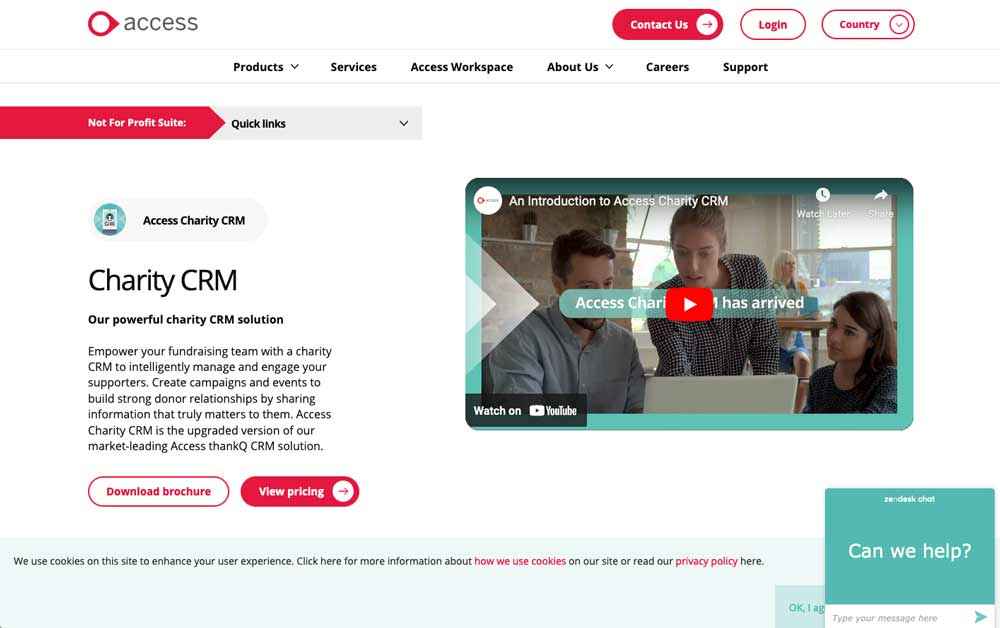
Access Charity
The Access Group is a renowned provider of business management solutions, and the Charity CRM is one of its products. The Access Charity CRM is an Access thankQ CRM solution upgrade designed to empower fundraising teams. It centres on effective management and engagement of supporters. It ensures supporters can easily access campaigns and essential information, thus creating solid relationships. Notable features of the Charity CRM include:
- Fundraising management, where Charities can create personalized communications targeted at different audiences.
- Donor management, where Charities can track supporter interactions centrally.
- Marketing automation, where Charities can integrate the system with Mailchimp to get more out of the collected data.
- Charity event management, designed for effective event planning and reporting.
There is also the direct debit payment processing and reporting and analytics feature. The inbuilt calling application also allows seamless communication between Charities and their supporters. The interface is simple but effective. Called the Fundraising Hub, this interface makes it super easy to access donor data and take desired actions without any prior expert knowledge. In addition, anyone in the organisation can access the dashboard without needing an extra CRM license. The system provides unlimited access and unlimited user licences, so all staff and volunteers can use the platform without additional costs. There is also a handy Donor Journey dashboard, where organisations can see the stage of each supporter’s journey.
Reliable technical support is available with Access Charity CRM, which is crucial for successful implementation, customization, and daily use. Access Charity CRM offers dedicated support with a specialized support team to provide personalized assistance and training, ensuring charities receive ongoing help tailored to their needs.
This might not be your ideal CRM if your Charity is big on service delivery data. The Access Charity CRM is primarily designed with fundraising and membership management in mind. Therefore, it does not handle other organisational requirements as efficiently.
User feedback and references from other charities can provide valuable insights into the strengths and weaknesses of Access Charity CRM, helping you make a more informed decision.
Plans and Pricing
There are three packages on the Access Charity CRM:
• the Essential Fundraising package is the starter package, allowing up to three users and unlimited contacts or supporters, for £250 monthly;
• the Growing Fundraising package is the standard package, allowing up to 10 users and unlimited contacts or supporters, for £525 monthly; and
• the Advanced Fundraising package is the premium package, allowing up to 30 users and unlimited contacts or supporters, for £833 monthly.
Find out more about Access Charity here
Salesforce
Salesforce is a high-performing multifaceted CRM product best suited to a small or medium organisation or business with a larger team and complex needs. It is often touted as the most powerful CRM software in the market, thanks to its excellent functionality and wide versatility. The non-profit version of Salesforce is hosted in the cloud, offering a wide range of features that meet the specific needs of Charities. These include tools for retaining and monitoring donors and features for data collection, storage, and reporting of processes and activities.
The strongest point of Salesforce is its collection of features. This beast of a CRM system will handle every task you throw at it as a charity organisation. It is highly customizable with a dedicated dashboard and can be integrated into any external system. The ‘chatter’ function comes in handy for cross-departmental communication. Salesforce provides extensive training resources, including documentation, tutorials, videos, and user forums, to support onboarding and ongoing use. However, despite the availability of these training resources, inadequate training and support for staff can still hinder effective utilization of CRM software.
Pricing remains the biggest downside of using Salesforce as a CRM. It will most likely be expensive for small charities working on a budget. However, registered charities can benefit from Salesforce’s special programs, which include discounts and free licenses to support CRM adoption. It is also best to have a prior experience with the system to get the best out of it.
Plans and Pricing
Salesforce has four pricing plans:
• the Salesforce Essential plan costs £20 monthly and covers up to 10 users
• the Salesforce Professional plan costs £60 monthly and allows unlimited users
• the Salesforce Enterprise plan costs £120 monthly and allows unlimited users
• the Salesforce Unlimited plan costs £240 monthly and allows unlimited users
Find out more about Salesforce here
Blackbaud
The Blackbaud CRM software is one of the very few CRM systems out there that is specifically designed for non-profit organisations, particularly large charities with complex relationship management needs. This cloud-based fundraising and relationship management system runs on Microsoft Azure. The official website says the software combines “fundraising expertise with complete non-profit CRM software solution to empower fundraising programs.”
In addition to fundraising and customer relationship management, this CRM software offers integrated analytics, multichannel marketing, and data mining features to help medium and large organisations build and nurture more robust and productive relationships with their donors and supporters. With the Blackbaud CRM software, charities and non-profit organisations can take advantage of an integrated approach to online donation, peer-to-peer fundraising, multichannel marketing, and database segmentation to achieve set organisational goals.
It is more suitable for larger organisations with its long list of comprehensive features. Blackbaud CRMs offer charities access to enterprise-level tech that enhances operational efficiency while attracting, engaging, and retaining donors and supporters. The software is built to serve non-profits out of the box, focusing on relationship building. It also provides an excellent multichannel marketing outlet and a content management system (CMS) that boost organisations’ online presence and reach.
Only a large charity organisation can maximize the Blackbaud CRM system’s robustness. The powerful tool will most likely be underused by a smaller organisation that requires no advanced functionality. In fact, the complexity of such CRM systems can overwhelm small charities, making them difficult to navigate and utilize effectively. The pricing and learning curve required may also be overkill for smaller organisations.
Plans and Pricing
The Blackbaud CRM system pricing plans depend on the number of records an organisation keeps and the level of functionality required. The company is always ready to provide a custom quote on request based on these criteria. You can also request a demo to test how it works.
Find out more about Blackbaud here
HubSpot
HubSpot may be the surprising entry on this list, but it has made it because it is an innovative marketing solution. The excellent marketing features of the HubSpot CRM system make it an efficient system for attracting donors and supporters. It is also the best choice for Charities that does seasonal fundraising, thanks to its permanently and generously free plan and unlimited users. The system also shines at handling all the repetitive outreach tasks, freeing up more time to focus on other important aspects of the projects. For example, sending follow-up emails straight to the donors from the dashboard is easy. There is also an auto-response feature that helps engage donors and supporters.
The platform is compatible with and implementable across multiple channels, including website builders, making it ideal for lead generation through pop-ups and web forms. Another plus is that it is relatively customizable and allows users to access more features via plugins at relatively lower costs. A free library of resources is also available, dedicated explicitly to non-profits and charities. HubSpot is considered an affordable option for charities, especially when comparing CRM systems and evaluating license fees, user costs, and implementation expenses. You may not get the best social media integrations with the free plan. The customer support tools are also not the most efficient, and there are no security emails. However, telephone support is available as an add-on for training and technical help beyond basic features.
Plans and Pricing
There are three pricing plans on the HubSpot CRM:
• the HubSpot Free plan that allows an unlimited number of users for £0;
• the HubSpot Marketing Hub plan that allows an unlimited number of users for £42 per month or £38 when billed annually; and
• the HubSpot Sales Hub plan that allows two free users for £42 per month or £38 when billed annually.
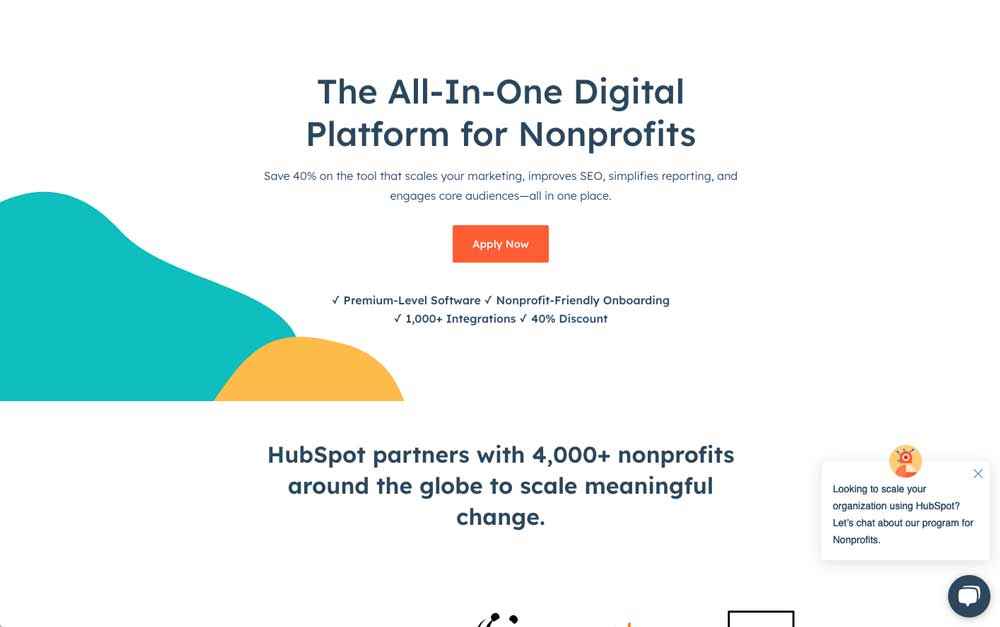
HubSpot for Nonprofits offers a 40% discount for eligible non-profits, making it an excellent choice for marketing-driven engagement.
Find out more about Hubspot here
Pipedrive
Pipedrive goes beyond a standard charity CRM by offering nonprofit-only features. You can use it to control volunteers, track event attendance, and build relationships with the community. Not to mention, it has an easy-to-use interface so your team will be able to go from A to B with minimal training. Most nonprofits face budget pressures and Pipedrive knows that. The competitive price means even smaller companies can have access to powerful tools. If your nonprofit is expanding, Pipedrive is growing with you, enabling scalable solutions for ever-increasing demand. Pipedrive is also highly customisable, allowing you to tailor features, data fields, dashboards, and integrations to suit your organization’s specific needs. Data management is a significant challenge for charities, particularly in maintaining accurate and up-to-date information within their CRM systems, and Pipedrive’s tools can help address this issue.
Pipedrive is ideal for small- to medium-sized nonprofits that care about simplicity, affordability, and usability. If you’re dealing with donors, small teams or specialized campaigns, Pipedrive’s easy-to-use interface and scalable tools are a fantastic fit. It’s ideally suited for companies who prefer automation and simplification over highly sophisticated or custom solutions. Pipedrive’s easy-to-use interface is perfect for nonprofits who don’t have a lot of technical knowledge or time to get started. The same applies to organizations that want to manage simple donor pipelines or smaller-scale fundraising campaigns because of its adaptability and affordability.
Pipedrive might not meet all your needs if you’re a large nonprofit with an extensive work stream, complicated programs, or highly tailored reporting requirements. It does provide robust reporting capabilities, but if you have complicated grant management, compliance, or highly customized workflow needs, you might be better off with something like Salesforce Nonprofit Cloud or HubSpot CRM. These platforms, while more sophisticated and costly, are designed for businesses that require higher levels of customisation and integration options. Furthermore, if your nonprofit is heavily relying on sophisticated analytics or precise financial tracking, a CRM built for that purpose could be a better fit.
Plans and Pricing
- Essential Plan: Starting at $14.90/user/month (billed annually), it’s perfect for small nonprofits who want simple donor management and reporting tools.
- Advanced Plan: For $27.90/user/month, it provides email integration and automation for your workflows.
- Professional: Pay $49.90 per user/month to unlock bespoke reporting, custom dashboards, and powerful team collaboration tools.
- Enterprise Plan: Available at $99/user/month, the enterprise plan offers unlimited features, support, and advanced customization — great for nonprofits with complex needs.
Find out more about Pipedrive here
Sumac CRM (by Societ)
Sumac CRM was designed specifically for nonprofits, giving you tools tailored to your organization. Designed for agility and ease of use, Sumac CRM is ideal for organizations to have everything from fundraising to event management at their fingertips. Sort your donors, record giving histories, and categorize supporters for targeted communication. With Sumac, maintaining enduring donor relationships is simple. Sumac CRM is also well-suited for membership organisations, offering features that help manage complex relationships, memberships, and charitable activities over time. The system also enables charities to efficiently receive referrals from websites or other sources and manage them directly within the CRM.
Sumac claims to be unique in that it’s modular (it’s not, others such as infoodle are also), meaning nonprofits select exactly what they need: event management, volunteer management, or grant management. That versatility means it can be used for any organization, big or small. From giving to monitoring campaign success, Sumac CRM gives you the tools to grow your fundraising operations. Its seamless integrations with payment processors make online giving and reporting easy. By storing availability, skills and hours, Sumac keeps your volunteers organised and ready to serve you. However, integration of CRM systems with other software can be complex, sometimes resulting in data silos and incomplete views of supporters and donors.
Sumac CRM is a perfect fit for nonprofits who need a solution that is tailored to their unique needs. The modular nature allows organizations to create a CRM tailored to their exact needs, without sacrificing essential functions. If you’re a nonprofit that prefers flexibility and ease of use over overly elaborate solutions, Sumac CRM is your best bet. It May Not Be Best For Larger, Highly Complex Businesses. Although Sumac is incredibly flexible, large nonprofits with complex workflows or enterprise requirements may prefer the larger platforms such as Salesforce Nonprofit Cloud for more sophisticated features at a higher cost.
Beyond these core functionalities, Sumac CRM supports case management for social service providers and membership management for associations. It’s that specific functionality that makes it so appealing for nonprofits with specialised operations.
Plans and Pricing
Sumac CRM’s pricing plans are tailored to nonprofits of all sizes. Rather than multi-tiered subscriptions, Sumac charges you by modules and functionality. This “pay as you go” model makes it affordable and scalable. Some key points include:
Base Pricing: $35 per month for the main CRM feature.
Add-Ons: Additional modules such as volunteer management, event management, case management are paid add-ons.
Customisation and Setup Fees: Premium additional services for customizing the platform or assisting with setting up may be charged as a one-time fee.
Beacon
Beacon CRM is a UK-based, cloud-based CRM built just for charities and non-profits, featuring a sleek, contemporary design that aims to be easier to learn and use than many traditional systems. As a cloud-based CRM, Beacon offers accessibility and flexibility for charities, enabling remote access, workflow automation, and easy integration with other systems. It provides an all-in-one fundraising, donor management and communications suite with a no-code approach and a platform designed to be easier to navigate. Beacon CRM is well suited to small and medium-sized charities that are looking to replace complex or legacy databases with an affordable and user-friendly alternative that covers all their core CRM needs.
Features are UK-focused, with native integration with Gift Aid, GDPR and straightforward native features for donation forms and email campaigns. They also integrate with UK essentials like Stripe and GoCardless for payments and Xero for accounting. A dashboard and visual design lets users quickly access data on their campaign performance and supporter base without the need for custom reports.
Beacon is a good fit for growing charities that value intuitive navigation, easy set up and a modern user experience over highly configurable, enterprise-level features. If you are seeking an affordable all-in-one system to manage your key functions without a steep learning curve, Beacon should be at the top of your list. Beacon is the latest in the new wave of charity-focused CRMs that also put a lot of value into great design.
Plans and Pricing
Beacon has a simple tiered pricing model based on the number of active supporters you have. Tiers and pricing can be found listed on their website. They offer a free demo.
Donorfy
Donorfy is a cloud CRM built and designed for the UK charitable sector. Native to Salesforce, it prides itself on being modern and open. Sector-specific functionality combined with the strength of a global technology platform offers an intuitive user interface with powerful fundraising, communications and donor management features. The platform aims to be a single source of truth, where an over-complicated admin burden can be quickly simplified.
Core strengths include pre-built integration with the popular UK-specific tools and platforms such as JustGiving, Enthuse, Xero and Mailchimp, leading to a natural flow of data throughout the tech stack, a platform built for automation to help teams easily schedule targeted and personalised communications, manage Gift Aid claims quickly and easily and offers visibility of supporter journeys. Donorfy is focused on community, events and digital income types, making it particularly suitable for hybrid charities with mixed fundraising channels.
The system lends itself to small to medium sized rapidly scaling charities who want a flexible and agile system with scalability without high upfront investment in IT. They target organisations who want a system built for charities and trusts rather than a bolted-on CRM that can feel heavy or legacy to implement and navigate. It is positioned as a donor-centric CRM with strong out-of-the-box functionality. Cloud-based charity CRM systems like Donorfy are becoming more popular due to easier data management and accessibility.
Plans and Pricing
Donorfy is based on a monthly subscription fee with pricing tiers based on the total number of supporter records, available on their website. The subscription fee covers ongoing access to the platform, and pricing increases incrementally with capacity and is transparent and simple to understand. The platform is demoable and provides a free trial for qualifying charities.

Lightful
Lightful is a relatively new, design-led CRM with integrated social media management and comms tools. Its strong points are its clean interface and a focus on creating and sharing a digital narrative.
It’s a platform designed with the digital native charity in mind, and one that values its digital presence and story-telling as part of its fundraising and awareness raising efforts. Charity digital platforms, such as Charity Digital, play a key role in supporting digital transformation for charities by offering access to discounted software solutions, including CRMs like Lightful.
Essential CRM features for contacts and campaign management are bundled with social media creation, scheduling and analysis tools across the main networks. Data analytics capabilities are a key trend in charity CRM systems, enabling organizations to better understand donor behavior and optimize fundraising efforts. Its value proposition is a streamlined service for small teams looking to run synchronised campaigns that link donor data with public-facing engagement. Automation is a strength but this isn’t a tool designed to replace humans.
Lightful seems most suited to the small-medium sized charity, in particular those with a digital-first mindset, or those put off by the perceived complexity and business-focus of existing CRMs. We can also see it being a fit for organisations where marketing, comms and fundraising responsibilities are merged across small teams.
Plans and Pricing
Lightful charges by a simple monthly subscription, with the pricing breakdown on the website. Plans tend to be structured on the number of contacts and breadth of features you need and are thus easily predictable.
Bloomerang
At the heart of Bloomerang is donor retention. The CRM is designed with a focus on retaining donors with a simple user experience, guided by retention metrics and prompted to keep supporters active. Lapsed supporters are emphasised, touchpoints are tracked and stewardship activities are encouraged.
Functions include donation management, communications, volunteers and events, all accessible from a clean and modern dashboard. The platform provides useful templates and automations for thank-you emails, as well as automated renewal reminders that can be triggered by donor activity. Automated welcome journeys can trigger thank you notes and welcome sequences within 24 hours of a gift. Reporting is well developed for retention-based metrics, and Bloomerang’s accurate reporting capabilities help charities maintain transparency and make informed decisions about donor retention.
Bloomerang would be a great fit for charities of any size that want to move away from an acquisition-focussed mindset and to more deeply nurture and retain their existing donor base. The platform is also simple enough that it would be a good choice for charities with minimal dedicated fundraising staff.
Plans and Pricing
Bloomerang offers a tiered subscription plan that is paid monthly and is based on the number of active donor records. All plans include the core features of a CRM with advanced features in the higher tiers. Full pricing is clearly listed on their website.
CRM System Security: Safeguarding Donor Data
For UK charities, looking after donor data isn’t just the done thing – it’s a legal and a moral necessity. As charities get more and more reliant on digital tools, getting the right CRM system with top notch security is crucial to keeping sensitive info safe and keeping your supporters on side. A good CRM system should have some serious security bells and whistles to stop data getting out and to make sure you’re still playing by the rules when it comes to GDPR and other data protection regulations.
When you’re looking at a charity CRM, you want to be on the lookout for features like encryption (which keeps donor data safe as it’s being sent and while it’s stored) and secure storage (which ensures that all your data is safely locked away with regular backups). And access controls are a must – they allow you to set up user permissions so that only the right people can see or edit sensitive data. This isn’t just about reducing the risk of data getting out – it also helps keep operations streamlined by making sure that everyone has the right level of access for their job.
Access Charity CRM stands out in this area by offering comprehensive security features that are specifically tailored for the charity sector. With two-factor authentication, regular security audits, and tight access controls, Access Charity CRM helps UK charities keep their donor data safe 24/7. These measures give you and your supporters peace of mind knowing that their info is protected by a system that’s been built with security at its core.
By prioritising security when you’re choosing a CRM, you not only keep your organisation safe from potential threats – you also show that you care about using data responsibly – which is a big part of building strong relationships with donors and other stakeholders.
Summary: What’s the right charity/nonprofit CRM software for you?
You can’t just pick one size fits all when it comes to choosing the perfect CRM for your organisation. You need to find a system that fits your specific needs and helps you reach your goals. In most cases, it’s all about what your organisation wants and what it needs from the software. There are some CRMs on the market that are specifically designed for the non-profit sector – they help with relationship-building with donors, volunteers and other stakeholders.
- What’s your mission or vision all about?
- How many users are you going to need?
- Do you want a CRM that can integrate with the other software and platforms you’re already using?
- Do you want a bespoke solution, or something that just works off the shelf?
- Do you prefer a cloud-based system, or something that’s installed on your own servers?
Microsoft Dynamics 365 is a cloud-based system that has loads of CRM features including advanced machine learning and AI – making it a great option for managing fundraising, supporter activities and ops in the non-profit sector. DonorPerfect is a web-based donor management solution that’s got loads of standard fundraising functionality. CiviCRM is an open source CRM project built by and for non-profit organisations – it’s got loads of functionality for managing constituent info and building complex workflows.
Charities often get bogged down when they’re implementing new CRM systems – staff have to juggle this with their regular work, and migrating to a new CRM can be a right old pain, especially when it comes to getting all the data sorted out. Change management is key to making this process go smoothly – it means managing expectations, providing training and supporting users as they get used to the new system.
Making informed decisions means considering expert advice, best practice and current trends in charity CRM solutions. Integrating with other platforms is a big trend right now – it allows charity CRMs to handle all sorts of tasks like payment processing and comms in one system. Look for vendors who are committed to continually improving and developing their CRM solutions – this ensures that you get ongoing innovation and long-term support for your charity.
Your answers to these questions will guide your choice of CRM software. Remember, the right CRM solution is one that helps with your primary tasks, focus, mission and vision – it’s not just about administration.
Key Things to Consider When Choosing a Charity CRM
Choosing the right charity CRM system is a make or break decision that can shape the future of your organisation’s fundraising and donor engagement. When you’re evaluating your options, start by thinking about how well the CRM manages donor data – including features for gift aid processing and donor behaviour analysis. A user-friendly interface is vital – it means your team can quickly get up to speed with the new CRM system with minimal disruption.
Robust technical support is another key factor – look for a provider that offers quick assistance and comprehensive onboarding to help your team get up to speed. As your charity grows, scalability and flexibility become increasingly important. Choose a charity CRM system that can expand with your needs and easily integrates with your existing tools, such as accounting software or email marketing platforms.A cloud-based CRM system brings a host of benefits, not least of which is the ability for your staff and volunteers to access donor data and manage fundraising campaigns from wherever they are. And that’s a really secure way of doing things, as you can be sure that your donor information is safe. With the right reporting and analytics tools, you can keep on top of donor behaviour, campaign performance and all sorts of other metrics that will help you make informed decisions and build stronger relationships with your supporters and other stakeholders.
By carefully weighing up the different factors at play here – data management, technical support, scalability, integration, accessibility, and analytics – you’ll be well placed to pick a CRM that doesn’t just meet your needs today, but also supports your charity’s plans for the long-term.
Free CRM Options for Not-For-Profits
Lots of small charities and new organisations on tight budgets can really benefit from a free CRM. Options like Zoho CRM, HubSpot CRM, and DonorPerfect offer the basics, such as contact management, donation tracking, and a bit of email marketing – all without you having to break the bank. That makes it an awful lot easier for small charities to get their heads around their donor data and communications.
When you’re choosing a free CRM, though, don’t just look at the upfront cost – think about the level of technical support and training resources on offer. That can make a huge difference in how smoothly you can get up and running with the new system. Some free CRMs come with online tutorials, community forums, or even a little bit of live support – which can be a godsend as you get to grips with what’s on offer.
Just keep in mind that as you grow, so will your needs. Many free CRMs have paid upgrades with extra features, so consider what that might cost and what benefits you’ll get from scaling up. Also, think about whether the system has the flexibility to adapt as you grow, or if it can add new modules or users as you need them.
In the end, a free CRM can be a great starting point for organisations looking to streamline operations and get to grips with donor management, all without a huge upfront cost. Just choose one that meets your needs right now and has a clear path for growth as you develop.
Campaign Management: Running Effective Fundraising Campaigns
Running a successful fundraising campaign is about more than just enthusiasm – it’s about having the right systems in place, with a bit of organisation, some insight and maybe a few tools up your sleeve. A charity CRM system can change the way you manage campaigns by bringing all your donor data together, automating marketing efforts and giving you really powerful data analysis tools.
With a robust CRM system, you can segment your donor base, personalise your communications and keep track of every interaction as you go through your fundraising campaigns. Features like marketing automation and event management let you schedule emails, manage event registrations, and track donor engagement – all from one place. Not only does that save time but it also lets you make sure your messaging is targeted and effective.
Data analysis is just as important. By tracking what your donors are up to and how your campaigns are performing, your charity can figure out what’s working, make adjustments on the fly and generate reports to share with the team and stakeholders. Those insights help you build stronger relationships with your supporters and make the most of every campaign.
In short, by using a charity CRM system for campaign management, your organisation can run more efficient, data-driven fundraising campaigns, engage with donors more effectively and hit your fundraising goals with more confidence.
Implementing Your Charity CRM: Tips for Success
Introducing a new charity CRM software can be a bit overwhelming, but with the right approach, it can really make a lasting difference to donor management and organisational efficiency. Start by setting clear goals and objectives for the new system and make sure everyone from staff to trustees is on board and supportive of the change.
Pick a CRM system that fits your charity’s unique needs, taking into account things like scalability, how easily it integrates with your existing tools and the specific donor management features you need. Put together a good training plan to help your team get comfortable and confident with the new system. Make the most of any available training resources, such as tutorials, webinars or support from the CRM provider.
As you roll out the new CRM, keep a close eye on how things are going and get feedback from users. Regularly check how well the system is meeting your needs and be prepared to make adjustments as necessary. That proactive approach will help you deal with any problems early on and make for a smoother transition.
By following these steps, your charity can successfully implement new CRM software, streamline donor management and get ready for stronger relationships and more effective fundraising in the future.
Charity CRM Survey: Understanding Donor Behavior
The Charity CRM Survey gives a revealing glimpse into how UK charities are adapting to the changing landscape of donor management and engagement. By examining donor behaviour and preferences across the charity sector, the survey provides really useful insights that can help organisations refine their fundraising campaigns and build stronger relationships with supporters.
One of the key findings from the charity CRM survey is just how important personal communication and timely acknowledgments are in retaining donors. Donors are more likely to stay engaged if they feel valued and informed, so it’s essential for charities to use their CRM system to automate thank-you messages, track interactions and deliver tailored updates. That approach not only boosts donor loyalty but also streamlines operations, freeing up valuable time for staff to focus on mission-driven work.
The Survey Also Highlights A Trend That’s Probably Been On The Radar Of Many UK Charities For A While: more charities are adopting cloud based CRM solutions like Access Charity CRM to manage donor data and interactions. These systems have got a lot going for them – they’re flexible, scalable and cost-effective, making them a great choice for charities of all shapes and sizes. With cloud based CRM platforms, charities can access their donor information securely from anywhere, work with their team more efficiently and keep their data bang up to date.
Data analysis and reporting really came out of the survey results as a couple of crucial components. Charities that use their CRM to make sense of their donor data and campaign performance tend to do a lot better – they make more informed decisions, pick up on trends and adjust their strategies to get the best possible outcome. Modern CRMs frequently come with advanced analytics tools that let organisations track donor behaviour, measure the effectiveness of their fundraising campaigns and churn out standard reports for stakeholders – all of which add up to more successful fundraising outcomes.
Another key takeaway from the survey is the importance of data security and compliance. As charities get more and more data from their donors, it’s utterly crucial that their CRM system is secure and GDPR compliant. And that’s not just about protecting the data – it’s also about building trust with the people who matter most to charities: their supporters. Trust is key to long-term success in this sector.
To Cut A Long Story Short, the Charity CRM Survey shows just how important it is to invest in the right CRM software to help with donor management, data analysis and fundraising campaigns. By keeping an ear to the ground for the latest trends and making the most of cloud based CRM tech, charities in the UK can build stronger relationships with their donors, make better decisions and drive a greater impact for their causes. Whether you’re a small local charity or a big national organisation, choosing a solid, secure and user-friendly CRM system like Access Charity CRM can help you unlock new opportunities and reach your fundraising goals.
Charity Sector Insights: Staying Ahead Of The Game
Staying ahead in the charity sector is about more than just keeping up – it’s about reading the signs and being ready for change. The latest trends show that charities that are using a modern CRM system are better equipped to manage donor data, run effective fundraising campaigns and adapt to the changing expectations of their supporters. According to the charity CRM survey, the organisations that are doing it right are the ones that choose a CRM that’s highly customisable and user friendly – one that they can tailor to their unique needs without having to go through a steep learning curve.
It’s now pretty standard practice for charities to have advanced features like gift aid processing and membership management built into their system. Not only do these tools make admin easier, but they also help charities build stronger relationships with their donors by making sure every interaction is tracked and every chance for engagement is captured. By using a CRM system that lets them make data-driven decisions, charities can get to know their donors a bit better, refine their fundraising campaigns and set more ambitious fundraising goals.
In a sector where resources are often stretched, having the right system in place can make all the difference. By staying on top of the latest trends and investing in a charity CRM that evolves alongside their needs, organisations can stay agile, responsive and ready to achieve a greater impact.
Charity Digital: Leverageing Digital Tech
Digital is having a massive impact on the way charities operate – it’s essential that charities get to grips with the latest tech if they want to stay on top. Leverageing digital tools – lets charities manage their donor data more efficiently, track their fundraising campaigns in real time and engage with supporters across multiple channels.
By adopting a cloud based CRM, charities can enjoy greater flexibility, secure access to data from anywhere and the ability to scale as their needs grow. Charity digital platforms also come with ongoing technical support and guidance, helping organisations stay up to date with the latest digital trends and best practice. Ultimately, embracing digital tech lets charities build a stronger online presence, build stronger donor relationships and unlock new fundraising potential.
Future Trends In Charity CRM: Emerging Tech And Strategies
The future of charity CRM is going to be shaped by a wave of emerging technologies and innovative strategies that are going to transform how charities manage donor data and run fundraising campaigns. Artificial intelligence and machine learning are at the forefront, enabling CRM systems to process vast amounts of data, predict donor behaviour and personalise communications to really get donors engaged. AI-powered chatbots can even automate routine donor interactions, freeing up staff to focus on more strategic work.
Blockchain tech is also starting to make its mark in the charity sector, offering a secure and transparent way to track donations and make sure funds are used as intended. Not only do these advancements make data security a whole lot better, but they also help build trust with supporters – a critical factor in getting fundraising targets met.As charities continue to ride the waves of changing trends, it’s crucial to make the right call on CRM software. We’re talking about a system that’s flexible, ahead of the curve and able to keep pace with all the new tech that’s coming our way. By keeping a weather eye on the horizon & staying open to fresh ideas, charities can get themselves in a stronger position for long-term survival, make their operations more efficient and make informed decisions based on the data that matters. The right CRM will give your organisation the tools to get the most out of your data, squeeze the best out of your fundraising efforts and build strong, lasting ties with your donors in this ever-changing world.
The Bottom Line
The quality of your tools ultimately determines the pace of organisational growth.
We hope this article has given you a good rundown of CRM software and how they help manage people and meet other needs of charities, churches, community groups, and other non-profits.
But if you are still stuck, we’d love to help just get in touch!